What to check after an electric unicycle cutout
A cutout is the wheel giving up under you: the board stops balancing and the nose drops. Once you are back on your feet, the wheel needs a check before it goes back on the road.
Updated 2026-10-23
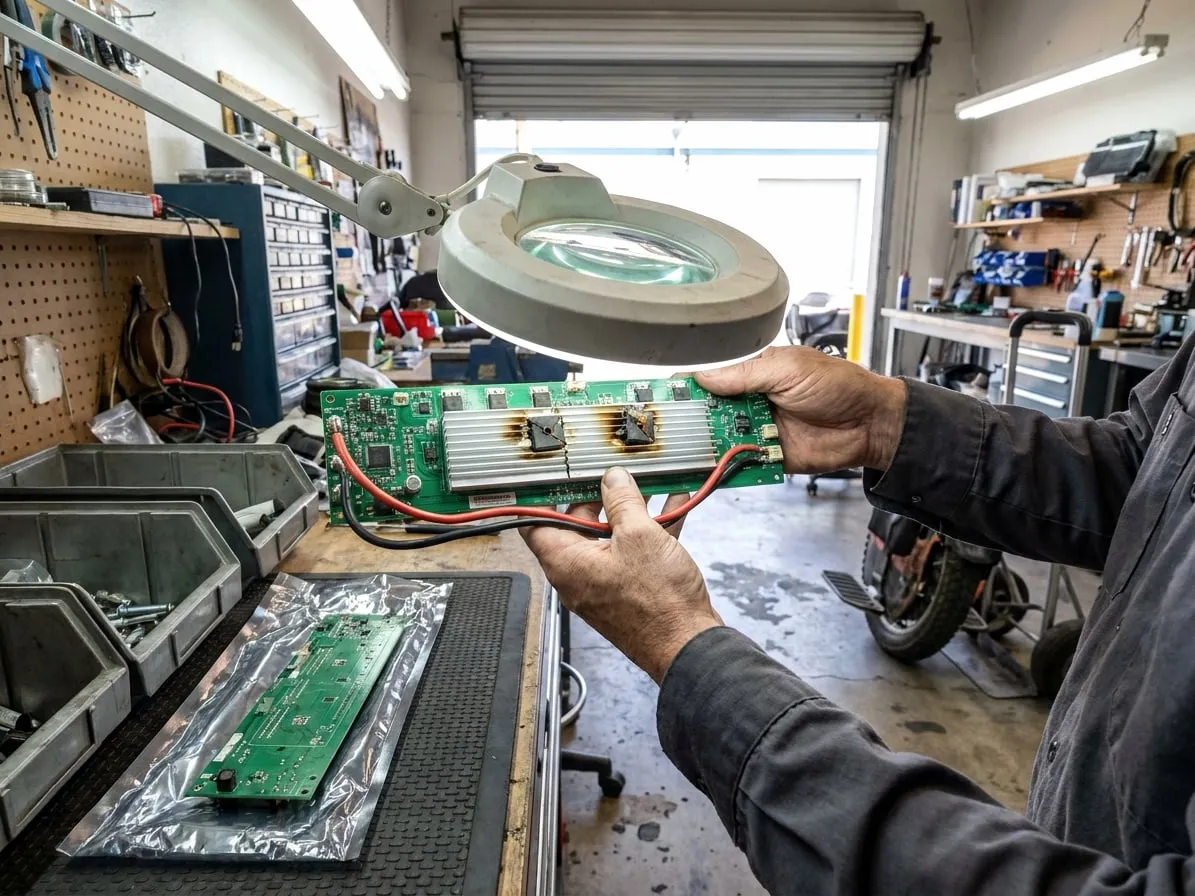
1. Do not power it on yet — turn the wheel by hand
With the wheel off, spin the tire by hand. It should turn freely with a slight magnetic cog. If it is stiff, brakes itself or locks, the board's power transistors (MOSFETs) have most likely shorted. Do not turn it on: a shorted board can do more damage.
2. Smell and look
- A burnt-electronics smell from the shell: the board. Leave the wheel outside and do not charge it.
- Swelling, a crack or heat from a side panel: the battery. Put it outside, away from the house, and text a shop.
3. Check what the fall hit
- Pedals: fold them up and down. A pedal that sits at a different angle or moves sideways has a bent hanger.
- Shell: cracks near the pedal mounts and the trolley handle.
- Tire: a cut or a bulge from the landing.
4. If it powers on normally
Check the app for an error, spin the wheel in the air and listen for grinding or stutter, and ride slowly in a parking lot first. Many cutouts come from leaning harder than the motor can push at that speed and battery level — warning beeps and tilt-back are the wheel asking you to slow down.
When it is a bench job
A stiff wheel, a burnt smell, an error that will not clear or a bent pedal hanger. We replace the board with an original one rather than a single transistor, test the motor and hall sensors, check the pedal hangers and the pack connectors, and balance-test the wheel on the stand before it goes back.
Tried all of that?
Then the fault is inside the wheel. We pick it up anywhere in Southern California, find the fault and quote it before any work — about a week from pickup to return.